Moles and Skin Cancer: Early Detection Plays a Crucial Role
Skin cancer is one of the most common forms of cancer worldwide, yet it is also among the most preventable and treatable—especially when caught early. While moles are usually benign, changes in their appearance can sometimes indicate cancerous growth. This transformation can be triggered by ultraviolet (UV) radiation exposure from sunlight or tanning beds, genetic predisposition, or a combination of both. Recognising these changes early and seeking medical advice promptly can make the difference between successful treatment and preventing life-threatening disease progression.
Skin Cancer in Western Populations
Skin cancer rates are highest among fair-skinned (Fitzpatrick Type I and II) individuals. This elevated risk stems from several factors:
- Lighter skin types have less melanin, which provides limited natural protection from UV radiation.
- Cultural and lifestyle habits, including outdoor sun exposure and tanning practices.
- Geographic factors, such as living in regions with high UV exposure.

Types of Skin Cancer
There are three main types of skin cancer:
- Basal Cell Carcinoma (BCC) – The most common and least aggressive form. It often appears as a pearly bump or a scaly patch. While most BCCs are slow-growing and rarely spread to other organs, prolonged neglect allows them to develop into a large, deep ulcer (sometimes called a rodent ulcer) that can invade vital structures like the eye or nose.
- Squamous Cell Carcinoma (SCC) – Can appear as a rough, scaly lesion or sore that doesn’t heal. If left untreated, can grow larger, spread to other parts of the body like lymph nodes and bone, and cause disfigurement. In rare cases, it can become life-threatening. However, SCC is highly curable if caught early, so prompt treatment is essential.
- Melanoma – The most dangerous form of skin cancer that can grow and spread very quickly. About 30% of melanomas begin in existing moles, but the rest start in normal skin. Melanoma most commonly spreads to the lymph nodes, lungs, liver, bones and brain. Melanoma survival rates vary significantly based on the stage at diagnosis, with Stage 0 melanoma having a five-year survival rate of nearly 100%. For Stage 4 (metastatic) melanoma, the five-year survival rate is around 50%.
How to Spot Suspicious Moles:
We highly recommend regular skin examination in order to spot new changes, such as:
- A new mole that looks different from your other moles.
- A new red or darker colour flaky patch that may be a little raised.
- A change in size, shape, colour or feel of a mole.
- A sore that doesn’t heal.
- A new flesh coloured firm bump.
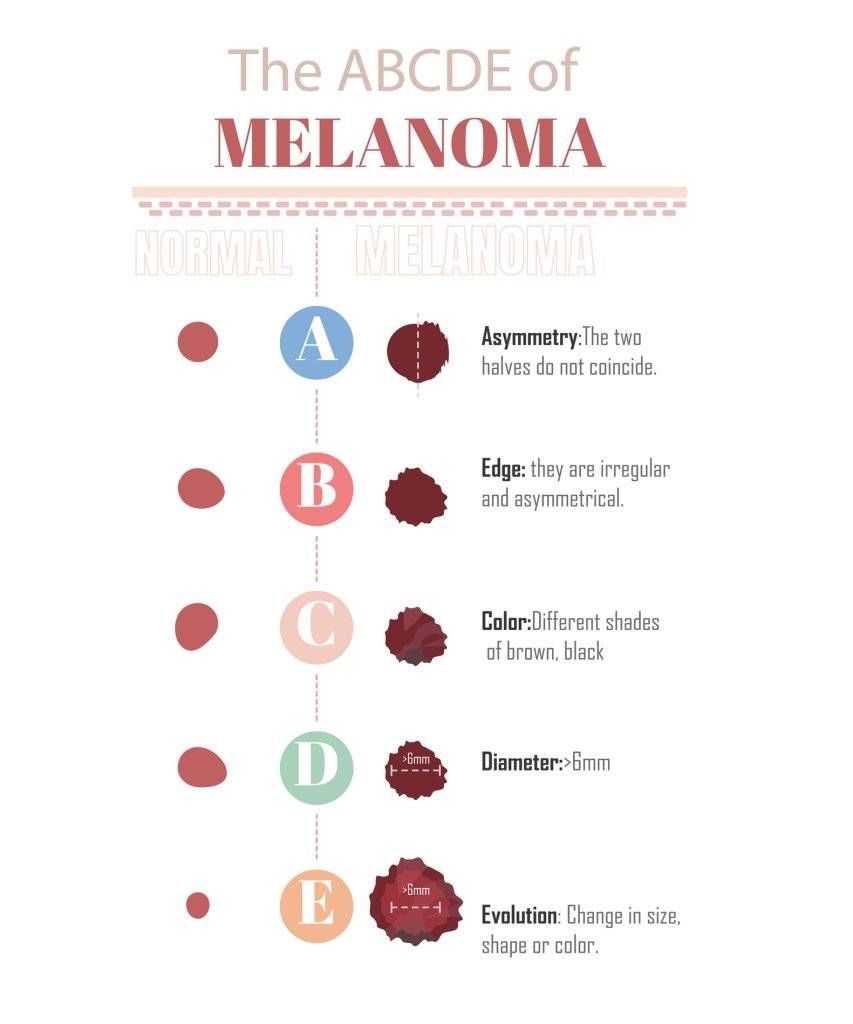
ABCDE Rule To Detect Melanoma Early:
The ABCDE rule is a common recognised screening tool used to assess suspicious characteristics of a mole: